

Accommodating variable male mating success
Some breeding operations mate each group of females with a group of males, leaving no control on who mates with who in the resulting mating group. The benefits include fewer mating paddocks/tanks, possibly fairer management group effects, and possibly better fertility. However, it is also likely that the numbers of matings per male is rather skewed, with one or a few males mating most of the females. Realised allocations can be detected by pedigree allocation of progeny to parents using genetic markers.
The MateSel MMG implementation has an Auto Correct feature which uses a method to accomodate variable male mating success.
Configurating Auto Correct
Section titled “Configurating Auto Correct”Auto Correct is enabled by default. To disable this feature, go to the Settings menu item and navigate the the Mixed Mating Group Coancestry Correction Option option:
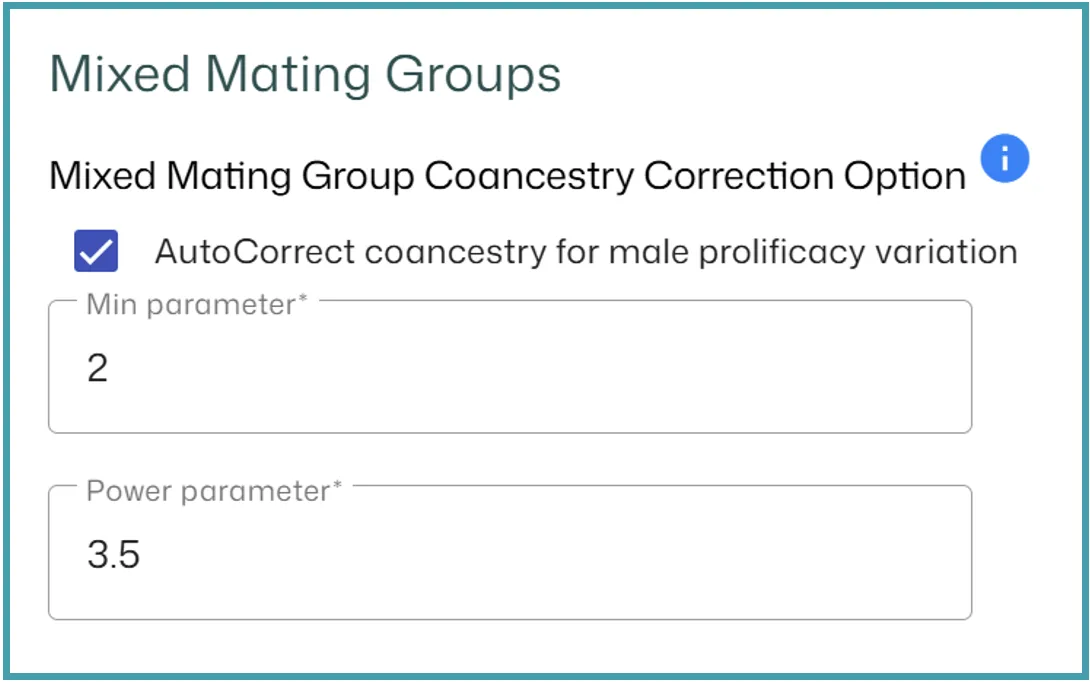
When Auto Correct is applied, the MateSel Frontier is built with coancestories calculated accommodating variable male mating success, passing through the blue solution below. Without Auto Correct the frontier will pass through the green solution.
Seeing the difference
Section titled “Seeing the difference”When using the Auto Correct option, you can visually compare the Auto Corrected Parental Coancestry vs the Parental Coancesty of equal male mating success on the Frontier by checking the Show equal male mating success option as shown below:
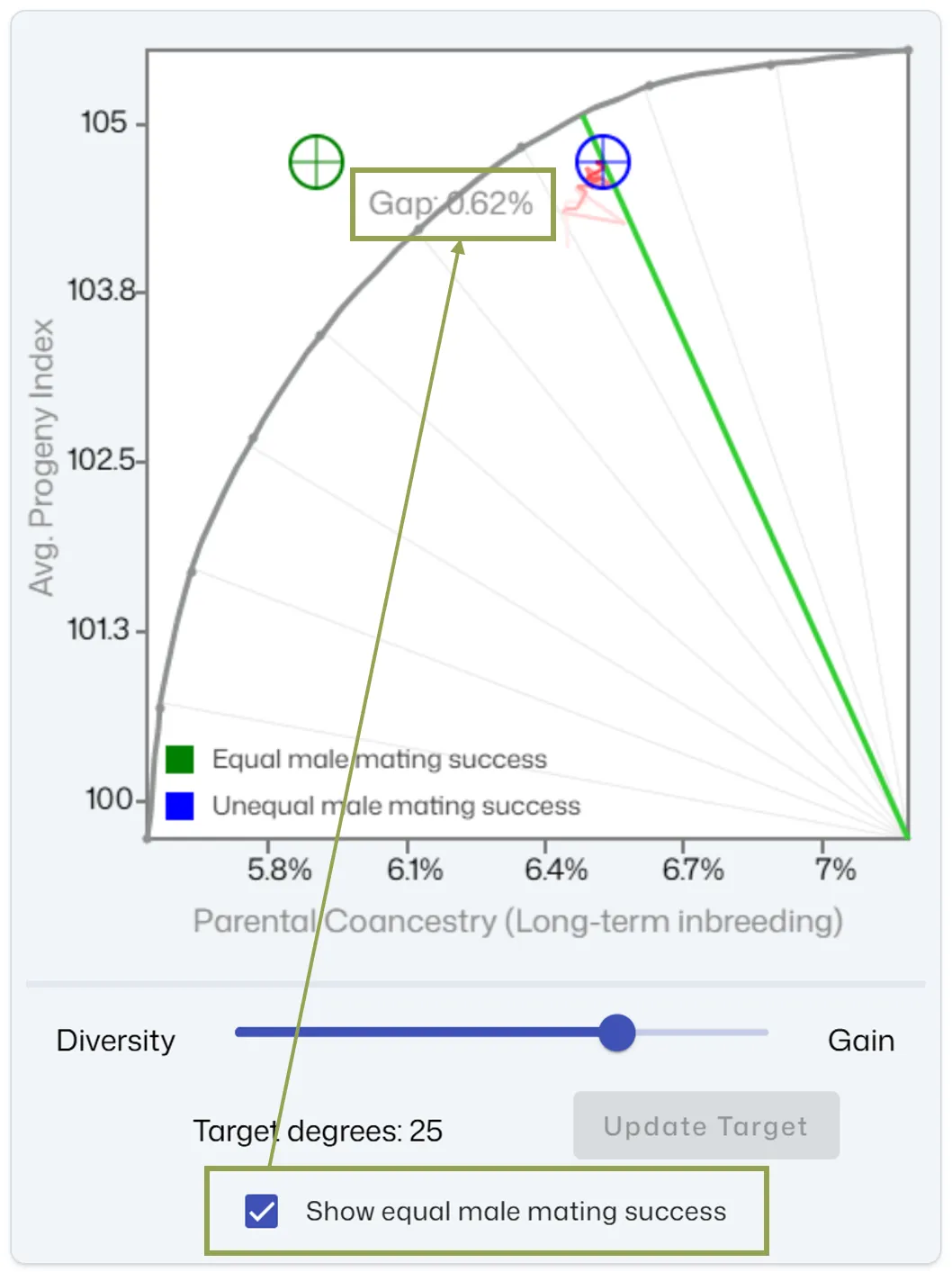
The green solution assumes equal contribution of males within each group, giving lower Parental Coancestry, and the blue solution shows the expected result when variation in male reproductive success is accounted for. The MMG gap is the difference between these in Parental Coancestry.
Where Auto Correct may not be required
Section titled “Where Auto Correct may not be required”Flow Control/Cohort Management
Auto correction is probably not important for assembly of groups for later mating decisions, for example, to populate multiplier herds or bull/boar AI stations, because male contributions will be controlled at actual mating time.
Open Pollination
Auto correction is probably not important for open pollination if competition between males for reproductive success is not so important. The video below should help you to edit parameters accordingly.
Females in Mass-Spawning Fish
Variable mating success could in some cases apply to females in mass-spawning fish, where variation in female fecundity can be high. However, each egg has a reasonable chance of resulting in a fish, whereas each sperm has a poor chance of resulting in a fish, and so it is in the males that competition is critical. If the variation in female success is not due to competition (e.g. the artificial environment itself affects egg release, rather than females compete for positions near males), then organising females into groups based on coancestry will probably not affect overall individual female contributions, and so the opportunity cost of doing this represents lost effort that could have been used on other issues.
Publication
Section titled “Publication”Please see the 2026 publication below describing this method in more detail.
A method to accommodate variable male mating success when managing diversity under mixed mating scenarios