

OCS Preselection
For larger datasets, you may want to consider using OCS preselection to optimise and reduce the search space. This can significantly reduce the time it takes to find an optimal solution.
This is how it works: In large datasets, the number of possible matings can be enormous and only a fraction of these end up in the final mating list. By generating an initial OCS frontier, individuals who contribute to any solutions are identified and OCS preselection boundaries are applied to preselect individuals for the MateSel run. In this way, OCS preselection allows you to reduce the search space by preselecting a subset of candidates to be considered for mating.
OCS Preselection Configuration
Section titled “OCS Preselection Configuration”You can configure this option under the Settings menu:
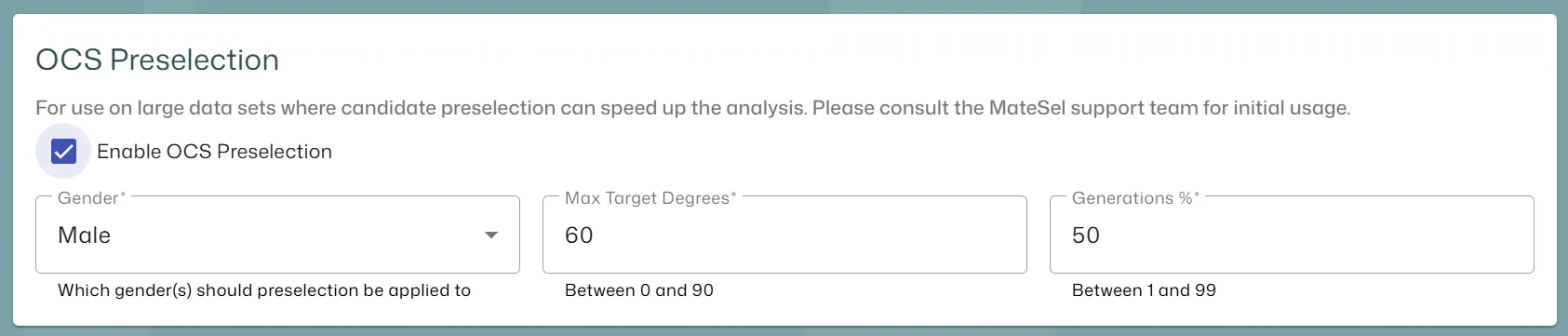
Gender - Select the gender (male, female or both) of individuals to undergo preselection.
Max Target Degrees - Maximum target degrees to consider in preselection. Candidates that are selected during Frontier building up to this Target Degrees will be preselected. Choosing a higher value means that more candidates will be preselected (lower stringency), especially given that more candidates will be selected at higher degrees, to achieve a greater maintenance of diversity.
Generations % - This percentage defines the lower cutoff used to preselect generations for each target degree in the frontier.
Example: For Max Target Degrees = 30, Generations % = 50, and Frontier generations = 2000 for all Target Degrees:
For evolution of Frontier points 0, 10, 20 and 30 degrees, any candidate that is selected in the best solution at any generation from 1000 to 2000 generations (top 50% of generations) will be preselected, and all other candidates will be excluded as candidates in the analysis.
During the run
Section titled “During the run”When OCS preselection is enabled, the Frontier will be built twice. Once to know which candidates can be preselected, and once to build the Frontier with the new (smaller) set of candidates. You will be shown the number of candidates before and after preselection at the top right of the screen:
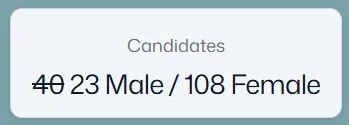
In the example above, we have asked for OCS Preselection for males but not females.